Ethnographic Sorcery by Harry G. West
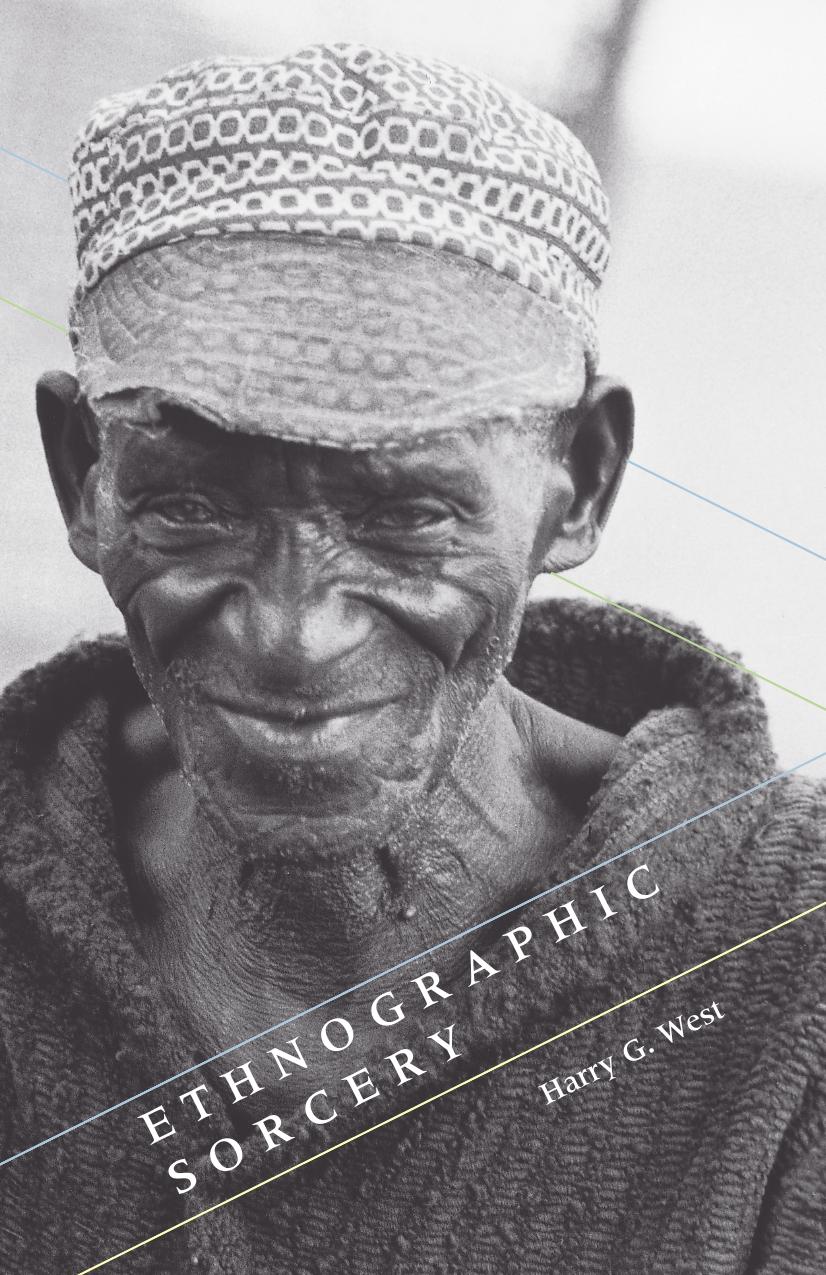
Author:Harry G. West [West, Harry G.]
Language: eng
Format: epub, pdf
Tags: Anthropology, Cultural, Social Science, General
ISBN: 9780226893983
Publisher: University Of Chicago Press
Published: 2007-04-30T18:30:00+00:00
“A language, and, insofar as it can be said to have conventions (which is how we, perforce, describe it), a culture, is the ultimate subjunctive, an ‘as if’ made into an ‘is’ by the seriousness of those who use it” (Wagner 1986: 8, emphasis added).10 Perhaps the only difference between the speaker of the phrase “George is a lion” and the sorcerer-producer of an ntumi wa kumpika lies in their degree of seriousness of imagination. Some people, Muedans realized, are dangerously serious.
WORKING WITH INDETERMINACY
If sorcery discourse constituted literal, or embodied, metaphors by which Muedans perceived and engaged with their world, sorcery was not the only language through which their world was conceived. In 1994, and again in 1999, nationwide multiparty elections were held in Mozambique to elect the president of the republic and members of Parliament. Through the electoral process, Muedans were introduced to the discourse of liberal democracy—a discourse whose animating logics differed greatly from those of sorcery. In the run-up to the vote, elections organizers (Mozambicans supported materially and logistically by numerous donor nations and a plethora of international organizations) articulated their own vision for the rationalization of power and the profound transformation of politics in postwar Mozambique. In accordance with their vision, elections organizers instructed Mozambicans to register to vote by having their photos taken and voter identification cards issued to them. These cards, and the bureaucratic electoral apparatus to which they were attached, may be said to have operated as a vast material metaphor (West 2003).
Elections organizers concerned with ensuring the credibility of electoral results—both to observers and to participants—suggested that the electoral apparatus effectively rendered the nation visible to itself in the moment of expression of the national political will. Within the electoral bureaucracy, each voter card and, later, each ballot paper operated as a metonymic extension of an individual Mozambican. The political will of that voter was made manifest by an X marked on his or her ballot card, which could be folded to conceal from observers the choice that he or she had made. When later removed from the ballot box and unfolded, each card represented for all to see the will of a single anonymous voter. Just as voter cards and ballots were standardized, the weight—the value—of each voter’s will was equal. Ultimately, the political legitimacy of each winning candidate was made manifest in the relative height and weight of the stack of ballot cards with Xs marked beside his or her name and photographic image compared with the height and weight of other stacks of ballot cards with Xs marked beside other candidates’ names and images. In this way, the elections process—as “literal metaphor”—was said both to represent and, simultaneously, to enact the confidential, yet transparent, measurement of the will of the Mozambican people and, hence, to rationalize political forces that heretofore had exercised power in hidden, arbitrary, and irrational ways.
Download
This site does not store any files on its server. We only index and link to content provided by other sites. Please contact the content providers to delete copyright contents if any and email us, we'll remove relevant links or contents immediately.
| Anthropology | Archaeology |
| Philosophy | Politics & Government |
| Social Sciences | Sociology |
| Women's Studies |
Born to Run: by Christopher McDougall(7132)
The Leavers by Lisa Ko(6952)
iGen by Jean M. Twenge(5419)
Sapiens by Yuval Noah Harari(5375)
Spare by Prince Harry The Duke of Sussex(5202)
The Kite Runner by Khaled Hosseini(5188)
Machine Learning at Scale with H2O by Gregory Keys | David Whiting(4317)
Bullshit Jobs by David Graeber(4197)
Never by Ken Follett(3963)
Goodbye Paradise(3813)
Livewired by David Eagleman(3778)
Fairy Tale by Stephen King(3403)
A Dictionary of Sociology by Unknown(3088)
Harry Potter 4 - Harry Potter and The Goblet of Fire by J.K.Rowling(3077)
The Social Psychology of Inequality by Unknown(3039)
The Club by A.L. Brooks(2930)
Will by Will Smith(2930)
0041152001443424520 .pdf by Unknown(2850)
People of the Earth: An Introduction to World Prehistory by Dr. Brian Fagan & Nadia Durrani(2740)
